SCA Project by Baron Snorri skyti Bjarnarson
Email: hivemind@mvgc.net Blog: www.snorri.blog
Project Overview
Human beings have played games with each other since before we evolved into homo sapiens; many instances of child-sized “toy” tools have been found in homo neanderthalensis (Neanderthal) archaeological finds. Many of these games will have been localized, played in small groups, settlements, and societies, and the most successful of them may have traveled long distances and spread regionally in antiquity. The simplest games are nearly impossible to definitively state an origin for, as things like rolling or throwing a ball, or throwing a stick at another stick, are so simple and universal that every society and culture could have developed similar games in parallel; such evolution and discovery needs no contact between cultures or civilizations, and can have been invented, lost, and invented again throughout history.
This research project and games demonstrations will encompass the history, equipment, and rules of outdoor games played on grass by adults in Western Europe before 1600 CE (within the SCA’s period of recreation). While this statement does a good job narrowing my focus initially, any project of this scope will necessarily need to drill down farther, to a point where the research is not overwhelmingly large, so some ground rules and reasoning for which games are included or excluded follows:
- I am excluding indoor games, such as billiards and dice games, and table games, such as chess, backgammon, and other board and card games.
- I am excluding games primarily played with no equipment, eg. boxing, footraces, swimming, wrestling, long/high jumping, etc. These games are more properly thought of as “sports”, in fact, sports have their origins in martial training, and not in recreation.
- I am excluding games played primarily by children, eg: hide-and-seek, tag, king of the hill, capture the flag, etc.
- I am excluding games with equipment that require physical skills that explicitly translate to martial activities, eg: archery, dodgeball, fencing, javelin, discus, hammer throw, etc. These games are also more properly thought of as “sports”
- I am excluding games that require a court or playing surface other than grass, eg: shuffleboard, curling, the Meso-American rubber ball games, surfing, etc.
- I am excluding games that require animals, eg. polo, horse racing, falconry
- I am excluding games which are played as a team, eg. football/soccer, lacrosse, field hockey, etc.
- I am concentrating on Western European lawn games at this time because, as an English speaker, research is easiest to find for this area. I acknowledge that these types of games probably exist in other areas and time periods and cultures; I’m just choosing to ignore them – for now.
Preliminary List:
| Game | Earliest Date | Location |
| Bocce/Bowls | 7400 BCE | Turkey, Egypt |
| Golf | 1300 CE | Netherlands |
| Tennis (handball) | 1100 CE | Northern France |
| Tennis (with rackets) | 1500 CE | France and England |
| Darts | 1300 CE | England |
| Bowling/Kegel/Skittles/Kubb | 1500 BCE | Egypt |
| Kyykkä/Kubb | ?? | Karelia |
| Horseshoes (maybe quoits) | 200 BCE | Rome? |
| Croquet | 1300 CE | France |
| Quoits | 100 CE | Roman-occupied England |
Note that this is a rough draft list, having come from a twenty-hour drive to Gulf Wars in 2024 with three other SCAdians in the truck with me. I expect that some of these will be removed, and others will be discovered and added, as I do this research.
Ancient Lawn Games: Bocce
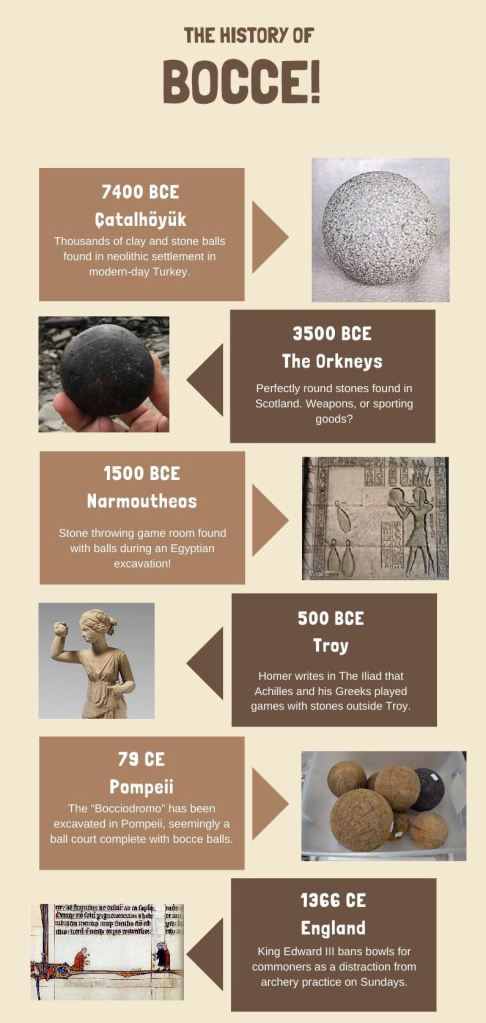
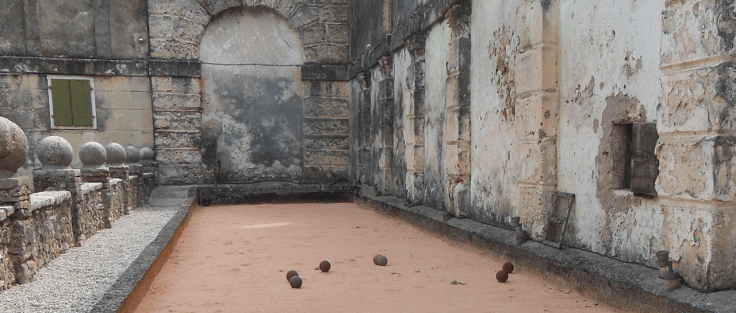
Fig.1: An ancient Venetian bocce court
Bocce is one of the oldest documentable lawn games. People playing ball games that look similar to bocce appear in paintings, carvings, and other art objects going back thousands of years:
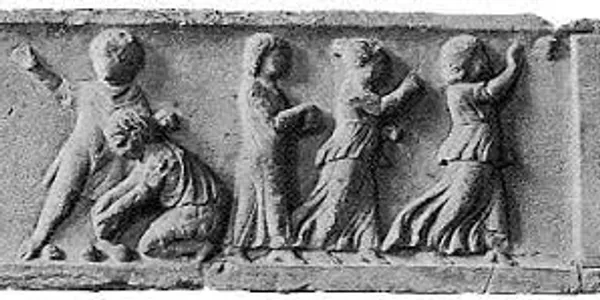
Fig.2: A frieze from a sarcophagus in The Louvre. Roman, 3rd century BCE
There were over 9000 clay balls found in the neolithic settlement of Catal Huyuk (Çatalhöyük) in Turkey, many of which are inscribed with various symbols.
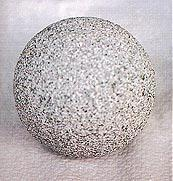
Fig.3: Lithic sphere found in Catal Huyuk, Türkiye.
While it cannot be definitively proven that they were used for games… no one can prove that they were not, either. At the very least, we know that ten thousand years ago, humans were making balls large enough to play lawn games with.
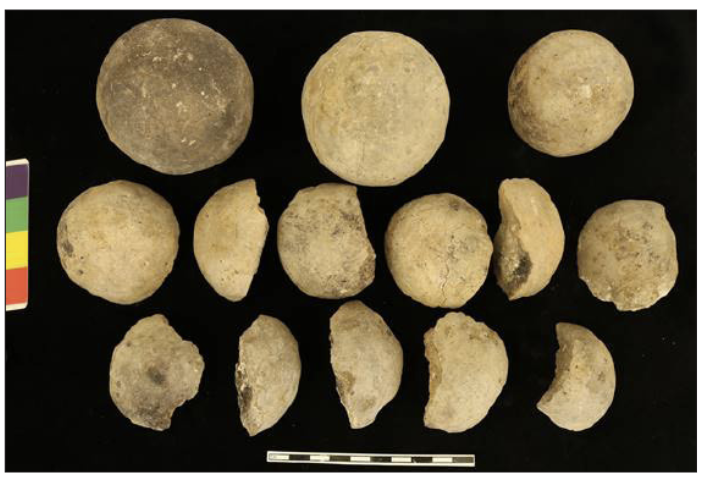
Fig.4: Clay balls and ball fragments from Catal Hoyuk, 7400-6200 BCE
There are lots of finds of neolithic stone balls in lots of places around the world. Some found in Scotland, and dated to 3500 BCE, are interpreted as weapons used to bash heads, based on skeletons found in nearby Orkney with skull fractures vaguely similar to those that would be caused by a stone ball.
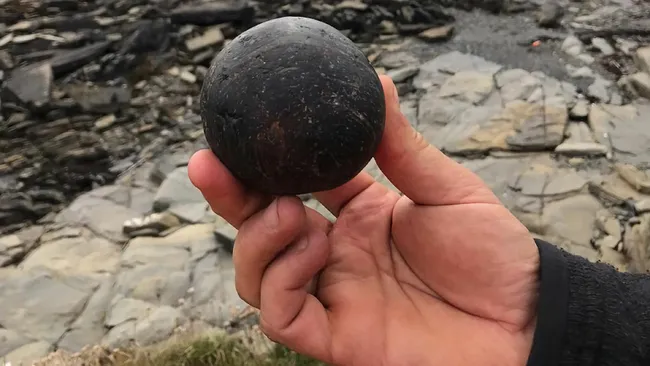
Fig.5: Scottish carved stone ball found in the Orkneys, 3500 BCE
I don’t really buy this explanation. Making a perfectly round stone is a lot of work, when any number of roundish stones found in any riverbed anywhere in the world would work just as well to bash in heads. Yes, mankind has spent an inordinate amount of time throughout history beautifying our weapons, but it just seems unnecessary here to make perfect spheres when oval river rocks would be functionally identical. You know what DOES require a perfect sphere though?
Balls for rolling on the ground in games.
There is also a lot of woo-woo conjecture around neolithic “Celtic” stone balls involving ancient aliens and obelisks and sundials and pyramids and such. I put this explanation at a distant third, well behind the “They’re for weapons” theory and the “They’re for games” theory.
A stone ball found in ancient Egypt, from between 1500 and 1450 BCE, has been explained as a “stone chipping tool” at the site of an “unfinished obelisk”, but explain to me how a round diorite stone is going to chip out rectangular sandstone blocks? Far more likely, in this researcher’s mind, that this excavation was the beginnings of the construction of a bocce court, abandoned when careless stonecutters accidentally cracked the block that was to become the boundary curbs of the court.
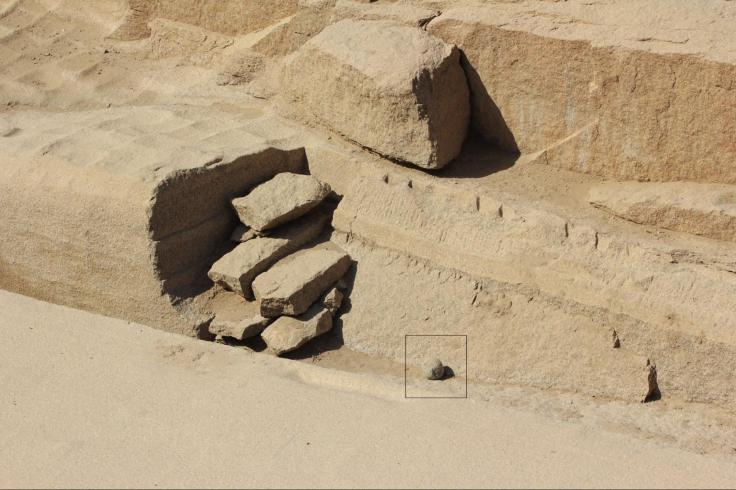
Fig.6: Ancient Egyptian bocce ball (conjectural) and abandoned bocce court (conjectural) construction, 1500-1450 BCE
The ancient Egyptians were actually prolific players and inventors of leisure sports and games. Another stone ball-throwing game was found at Narmoutheos, in the Fayoum region, some 90 kilometers south of Cairo. The court was found in a large room that seems to be the prototype of a modern bowling alley; the room was part of a structure, perhaps a residential building, dated from the Imperial Roman period, between the 2nd and 3rd century CE.
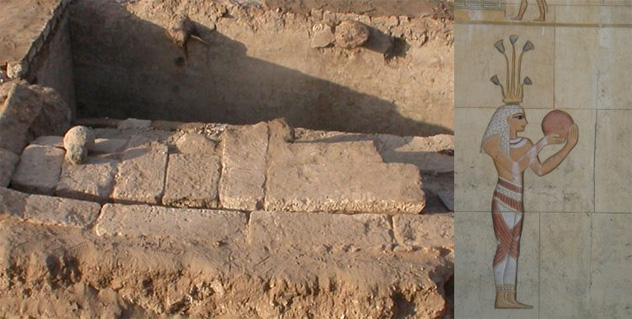
Fig.7: Stone balls and ball-court in Narmoutheos; Egyptian hieroglyph of a person playing bowls.
Evidence for a bocce-like game in classical Greece is clear; Homer himself says in The Iliad that during slow times at the siege of Troy, Achilles and his companions played at games by rolling stones.
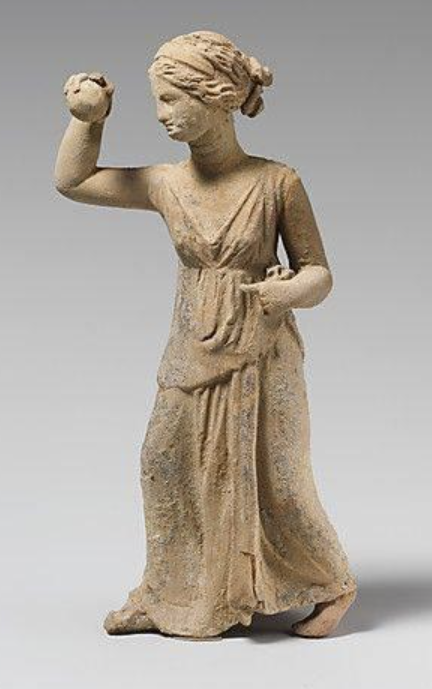
Fig.8: Terracotta figurine depicting a girl playing with a ball. Magna Graecia, 200 BCE
The ancient Romans were responsible for the leap in quality of the balls used to play bocce; it was them that first began making the game balls from wood, rather than stone or clay. The conquering Roman Legions carried the game far and wide, to Gaul, Germania, and Brittania.
The impact of Roman culture on the game of bocce is evident in its very name; “boccia” originates from the Vulgar Latin term “bottia,” which referred to a simple “ball.” It was the Romans who initially embraced the use of wooden spheres instead of stones and terracotta; they were known as “pili lignei.”
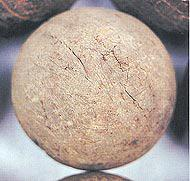
Fig.9: Olivewood bocce ball from Imperial Rome
Starting from the Middle Ages, this game gained popularity among people from different social backgrounds, with variations in materials and rules appealing to both commoners and nobility alike. England, France, Bavaria/Swabia, and Italy in particular were overrun with public crazes for bowls or bocce at various times.
In 1366, bowls received its earliest documented reference in England, with King Edward III issuing a ban on the activity, citing it as a diversion from archery training. This was just the beginning of government restrictions on bocce in England. The name “bowles” appears explicitly in a list of prohibited games in an act by Henry VII in 1495, alongside others like Tenys, Closshe, Dise, and Cardes. This reference reappears in a similar statute enacted by Henry VIII in 1511. Subsequently, the Unlawful Games Act of 1541, which remained in effect until 1845, restricted certain social classes, such as artisans, laborers, apprentices, and servants, from playing bowls except during Christmas and solely within their master’s premises. Moreover, it stipulated a fine of 6 shillings and 8 pence for playing bowls outside one’s own garden or orchard, with exceptions granted to landowners with properties valued at £100 or more, who could obtain licenses for private greens.
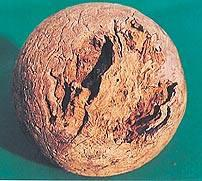
Fig.10: Poplar wood ball, England, 1050 CE
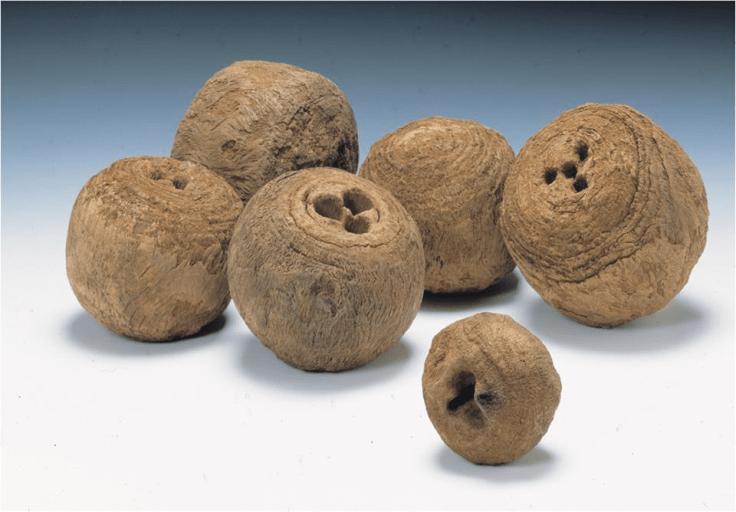
Fig.11: Wooden bowles dating back to the reign of King John “Lackland” (1199-1216), brother of Richard “the Lionheart,” were discovered in England
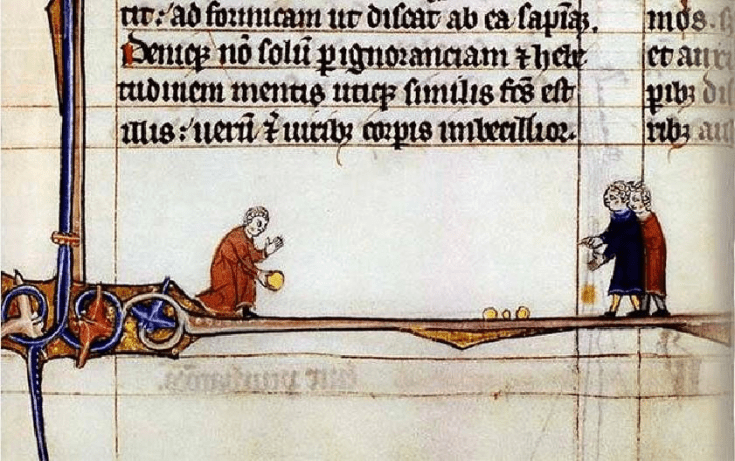
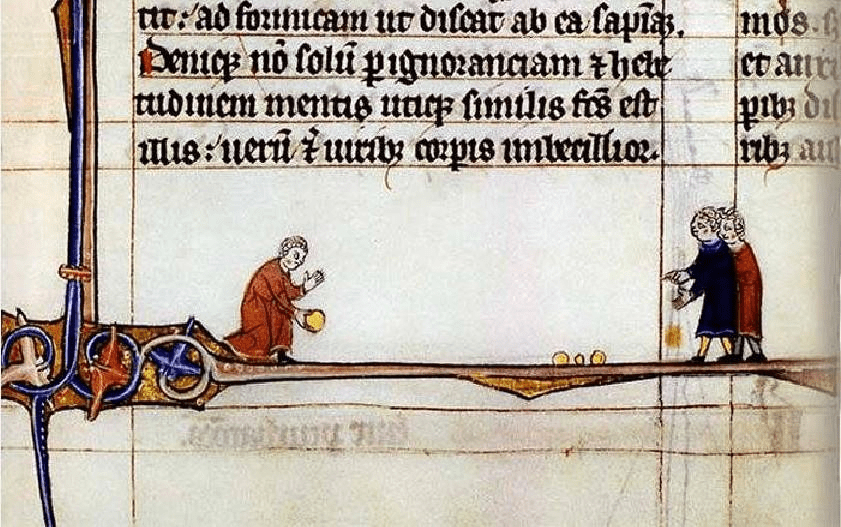
Fig.12: Marginalia of bocce players from a 14th century psalter
Gameplay Overview:
The game itself is simple, which is undoubtedly part of the reason for its longevity. The game is played with larger balls (80-120mm), usually colored in pairs, and a smaller ball (usually white, called the jack, the pallina/o, or the boccino). Two teams of one, two, or four players take turns rolling or tossing their balls in an effort to have them closest to the pallina. The team with the closest ball to the pallina gets a point, and the game is played to sixteen.
Gameplay Rules:
Historically, and in many places today, the starting team is determined by the morra. Similar to the game of “rock-paper-scissors” many of us are familiar with today, the two team captains will simultaneously display a hand with one-to-five fingers extended, while calling out their guess as to the total numbers of fingers displayed. This is repeated, rapidly, until one of them guesses correctly. If the players are not familiar with the morra, a coin flip can be an adequate substitute.
If there are multiple players on a team, they establish a throwing order amongst themselves. Once established, the throwing order may not change.
The number of balls thrown by each player depends on how many players are on the team:
- One player: player throw four balls
- Two players: each player throws two balls
- Four players: each player thrown one ball
Once a starting throwing team is determined, and the team’s throwing orders are agreed upon, the throwing team chooses their color(s), chooses which end of the court to start on, and the throwing team’s first thrower begins a frame (round) by tossing the pallina.
All balls are thrown underhanded.
The pallina must cross the centerline of the court, and must remain in-bounds. If the court has a border curb of stone, concrete, or boards, the pallina must not touch them. If the first team’s pallina toss is illegal, then the second team becomes the throwing team, and throws the pallina. If the second team’s toss is also illegal, the referee will seat the pallina manually, then the original throwing team resumes their place. If there is no referee present, then the teams continue to alternate pallina tosses until one is legal.
The throwing team’s first thrower throws one ball. This must be a legal throw; if it is not, the throw is repeated until a legal throw is made. Then the second team’s first thrower throws one ball, trying to get closer to the pallina than the first team’s first ball. If this, or any subsequent ball thrown by either team, goes out of bounds, or is otherwise illegal, the ball is not re-thrown.
Thereafter, whichever team is NOT closest to the ball throws. If they then throw a ball closer than the other team’s closest ball, they step back and let the other team throw. Play repeats in this manner until all of each team’s balls have been thrown. If at any time the pallina is knocked out of bounds, the frame ends with no score awarded, players switch ends, and the next frame is started.
Once all balls have been thrown, the frame is scored. Each ball closer to the pallina than the other team’s closest ball scores one point. Only one team scores points in each frame. Distances are measured from the center of the pallina to the edge of a ball. Most measurements can simply be made by pacing off the distance, heel-to-toe. Closer or disputed measurements should be made with a string or other measuring device.
The team awarded points in the previous frame begins the next frame by tossing the pallina and the first ball.
The game ends when one team reaches 16 points. Continue playing new frames until one team wins.
BIBLIOGRAPHY
Corpulent, Salamallah the. (1982). Medieval games. Raymond’s Quiet Press.
Daniele, R. (2000). Bocce: A sport for everyone. 1stBooks Library / AuthorHouse.
Di Chiara, D. (1997). History of bowls in Italy and in the world. From its origins to our times , 3 vols., Pomezia, Poligrafia.
https://boazz.com/history-of-bocce
https://bocce.org/history-of-bocce/
https://bocce.org/rules-of-bocce/
https://colleonibocce.com/en/the-game/
https://en.wikipedia.org/wiki/Bowling
https://en.wikipedia.org/wiki/Bowls
https://en.wikipedia.org/wiki/History_of_sport
https://en.wikipedia.org/wiki/Morra_(game)
https://en.wikipedia.org/wiki/Unfinished_obelisk
https://eprints.whiterose.ac.uk/83027/1/NeanderthalChildhood_OA_Images_sml.pdf
https://storiearcheostorie.com/2020/01/29/bocce-nella-storia/
https://www.abc.net.au/science/articles/2007/07/27/1989990.htm
https://www.ancient-origins.net/artifacts-ancient-technology/neolithic-stone-balls-0018317
https://www.archaeology.org/news/9977-210907-scotland-stone-balls
https://www.backyardbocce.com/basic-rules/
https://www.boccebuildersofamerica.com/history/
Layne, J. M. (2008). The enculturative function of toys and games in ancient Greece and Rome (Publication No. 1465411) [Doctoral dissertation, University of Maryland, College Park]. ProQuest Dissertations Publishing.
Tyldesley, J. A. (2007). Egyptian games and sports. Shire.
 Snorri's House
Leave a comment